monday.com Review 2026: AI Project Management for UK Businesses
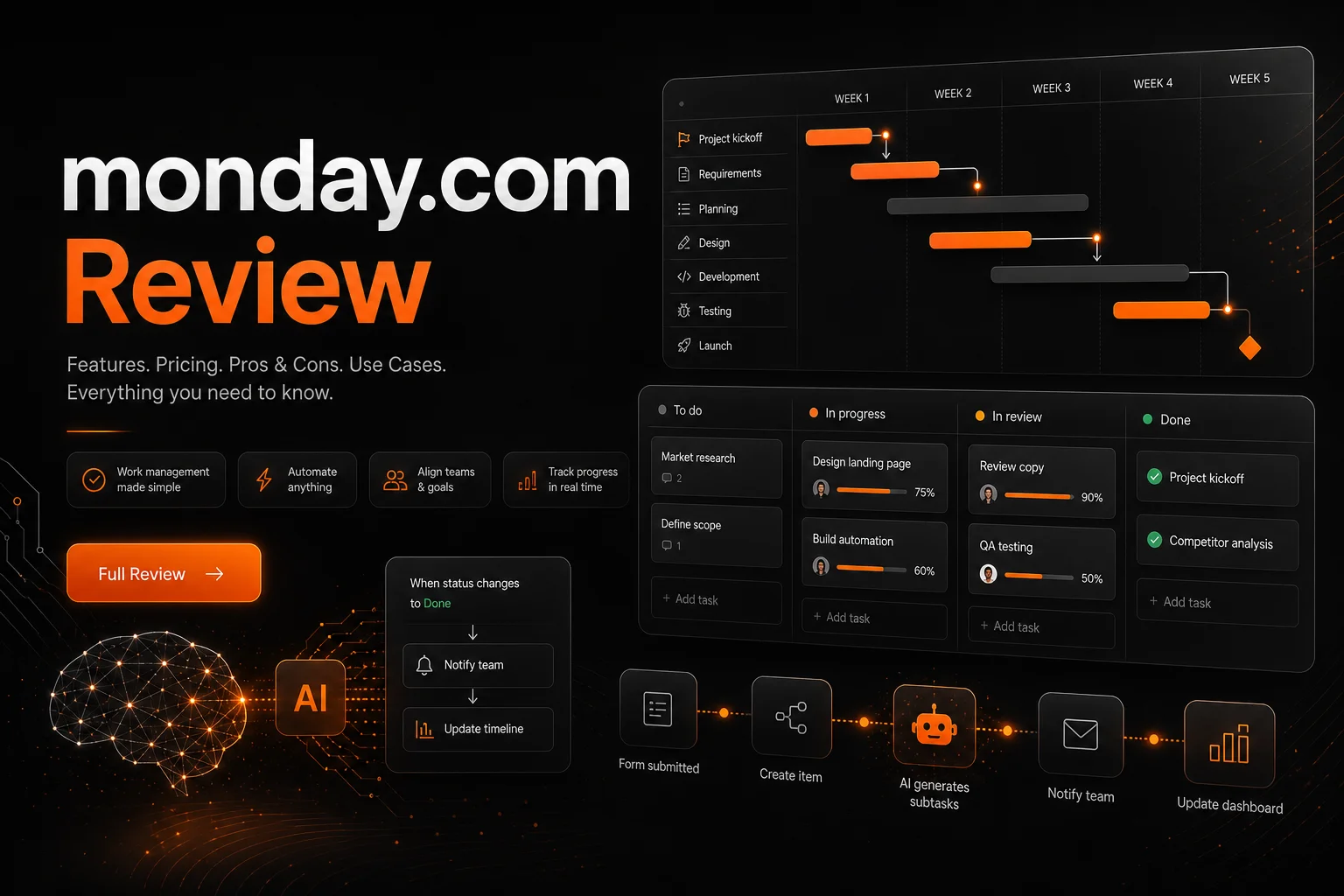

monday.com is one of the most recognisable names in visual project management. In 2026, the platform has undergone a significant transformation — relaunching as an AI-first work platform with native AI agents, a credits-based AI consumption model, and deeper automation capabilities. For UK small businesses evaluating project management software, the question is whether monday.com's feature set and new AI tools justify the per-seat cost in a market full of strong alternatives. This review covers the 2026 pricing in GBP, the new AI agent features, and whether the platform still delivers for its core audience.
How We Tested monday.com
We set up a full monday.com workspace and ran a 21-day evaluation using a real UK digital agency scenario. We tracked a website redesign project across all major views — Timeline, Gantt, Kanban, and Calendar — to assess how the platform handles complex project management workflows with multiple team members and dependencies.
We then tested the new AI agent capabilities, including the Sidekick assistant for project status queries, an AI agent configured for risk triage on overdue tasks, and a workflow automation that used AI to generate subtasks from form submissions. We measured setup time, accuracy of AI outputs, and how well the agents integrated with existing board automations.
Finally, we evaluated the platform's CRM features, automation builder, and integration ecosystem (Slack, Google Workspace, email integration) from the perspective of a UK-based team. We paid particular attention to GDPR compliance, data residency options, and the quality of UK-specific support resources.
Result: monday.com delivered a polished, highly customisable project management experience. The new AI agents are genuinely useful rather than gimmicky, though the credits-based pricing adds complexity to cost forecasting. We scored it on value for money in GBP, feature depth, ease of use, and fit for UK-specific business requirements.
Key Takeaways
- Visual project management with Timeline, Gantt, Kanban, Calendar, and Workload views — one of the most flexible viewing options in the category
- AI agents launched in February 2026 can triage risks, qualify leads, draft campaigns, and automate budget approvals — genuinely useful, not just marketing hype
- All paid plans require a 3-seat minimum, making the true starting cost ~£21/month for Basic (annual billing)
- AI credits are a separate purchase at $0.01/credit for new subscribers since May 2026, adding ongoing variable costs
- 200+ pre-built templates and a robust automation builder reduce setup time significantly for common workflows
What Is monday.com?
monday.com is a visual project management and work operating system that helps teams plan, execute, and track work through a highly customisable board-based interface. Originally launched in 2012 as a simple team management tool, it has evolved into a multi-product platform covering work management, CRM, software development (monday dev), and service delivery (monday service). The core experience centres on boards — visual tables where each row is a task or item and each column represents a data field such as status, assignee, timeline, or priority.
In February 2026, monday.com made its most significant strategic shift yet: it relaunched as an AI work platform with native AI agents built directly into the product. The new Sidekick AI assistant provides conversational project management — you can ask "What tasks are overdue?" or "Summarise this week's progress" and get an instant answer. Dedicated AI agents can be configured for specific roles: triaging incoming support tickets, qualifying sales leads, drafting marketing campaigns, running project workflows, and handling budget approvals. These agents operate under human supervision within monday.com's existing permission and security framework, which is reassuring for UK businesses with compliance requirements.
Beyond AI, monday.com offers the usual project management staples: Gantt charts, Kanban boards, Timeline and Calendar views, workload management, over 200 ready-made templates, and a powerful automation engine. It also includes CRM features — pipeline tracking, contact management, deal stages, and email integration — making it a viable option for small sales teams that want both project management and CRM in one tool. The monday Vibe product, launched alongside the AI push, lets teams build custom apps and AI-powered tools without writing code, with 17,000+ apps built in its first week according to the company.
Pricing (GBP)
| Plan | USD/seat/month (annual) | Approx. GBP/seat/month (annual) | Key Features |
|---|---|---|---|
| Free | $0 | Free | 2 seats, 3 boards, basic views, no automations or integrations |
| Basic | $9 | ~£7 | Unlimited boards, Timeline & Gantt views, 5GB storage, 3-seat minimum |
| Standard | $12 | ~£10 | Automations & integrations, Calendar & Guest views, 250 automation actions/month |
| Pro | $19 | ~£15 | Time tracking, private boards, Formula & Dependency columns, 25,000 automation actions/month |
| Enterprise | Custom | Custom | Advanced security, HIPAA, premium support, enterprise-scale automations, tailored onboarding |
*All paid plans require a minimum of 3 seats — minimum effective cost is £21/month on Basic (annual). AI credits are purchased separately at $0.01/credit for post-May 2026 subscribers. Monthly billing is available at higher per-seat rates. Prices exclude VAT. Visit monday.com/pricing for current rates.
Key Features
AI Agents and Sidekick. The headline feature of the 2026 relaunch, monday.com's AI agents can be configured to handle specific operational tasks. You can set up an agent to monitor project boards for overdue tasks, triage risks based on configurable rules, and send proactive alerts. The agents can also qualify sales leads from form submissions, generate draft responses for support tickets, and create subtasks and dependencies from high-level project briefs. Sidekick, the conversational AI assistant, lives in the sidebar and answers natural language questions about your workspace — "What's the status of the Q3 marketing campaign?" — pulling data from across boards and items. Both features use monday.com's AI Platform Gateway, which routes requests through multiple LLM providers (including OpenAI and Anthropic) for the best result.
AI Credits System. Since May 2026, new monday.com subscribers purchase AI credits alongside seats. One credit costs $0.01 and is consumed by AI operations — generating a task summary, running an agent action, querying Sidekick. Each capability consumes a different number of credits depending on complexity. This usage-based model means your AI costs scale with actual usage rather than being bundled into a flat per-seat price. For light AI users, this can be cheaper than a fixed add-on; for teams that lean heavily on AI agents, costs are variable and require monitoring to avoid surprises.
200+ Templates and Visual Views. monday.com ships with an extensive library of pre-built templates covering project management, CRM, marketing, HR, software development, and operations. You can start with a template and customise it extensively — add columns, change views, set up automations — without writing code. The platform supports eight different viewing options: Board (spreadsheet-like), Timeline, Gantt, Kanban, Calendar, Map, Chart, and Workload views. Each view draws from the same underlying data, so your team can work in whatever format suits them best without duplicating information. This flexibility is one of monday.com's strongest differentiators compared to tools like Asana or Trello.
Automation Engine. The built-in automation builder lets you create if-this-then-that workflows without coding. Standard triggers include status changes, date arrivals, form submissions, and email receipt. Actions include assigning tasks, sending notifications, updating columns, creating items, and triggering webhooks. The Standard plan includes 250 automation actions per month, which is tight for active teams; the Pro plan bumps this to 25,000 per month, which covers most operational needs. For UK businesses that want to automate repetitive project management tasks — moving tasks along a pipeline, notifying stakeholders of changes, escalating overdue items — the automation engine is robust and intuitive.
Integrations. monday.com integrates with over 200 third-party tools including Slack, Microsoft Teams, Google Workspace, Outlook, Jira, GitHub, GitLab, Zoom, Salesforce, HubSpot, Mailchimp, and Zapier. The integrations are bi-directional where supported — a Slack message can create a monday.com item, and a status change in monday.com can post to a Slack channel. The platform also offers a public API and webhooks for custom integrations, which is useful for UK businesses with bespoke workflows or legacy systems. The monday MCP (Model Context Protocol) support, released alongside the AI platform, lets external AI tools connect to monday.com data directly.
Pros and Cons
Pros
- Exceptionally flexible visual interface — eight viewing options that all draw from the same data source
- AI agents are genuinely useful for task triage, lead qualification, and budget approvals, not just AI window-dressing
- 200+ high-quality templates reduce setup time dramatically for common use cases
- Strong automation engine that covers most operational workflows without needing third-party tools like Zapier
- Bi-directional integrations with over 200 tools including Slack, Google Workspace, and Jira
Cons
- 3-seat minimum on all paid plans disadvantages solo users and 2-person teams
- AI credits add ongoing variable costs on top of per-seat pricing — harder to budget than flat-rate alternatives
- Standard plan caps automations at 250 actions/month, which is low for teams that rely on workflow automation
- Advanced Gantt features like critical path analysis and resource levelling are missing compared to Microsoft Project or Smartsheet
- Can feel overwhelming for simple task management — the flexibility comes with a learning curve and setup complexity
Is monday.com Right for UK Small Businesses?
monday.com works best for UK teams of 3 or more that need a visual, flexible project management platform and are willing to invest time in customising boards and workflows to their specific processes. The 2026 AI agent features are a genuine step forward — being able to say "flag any project tasks that are more than 5 days overdue and notify the account manager" without writing a complex automation is genuinely useful for small teams that don't have dedicated project management tooling.
The Standard plan at ~£10/seat/month (3-seat minimum, so ~£30/month total billed annually) is the practical entry point for most businesses, since the Basic plan lacks automations and integrations. At that price, it competes head-to-head with Asana Starter and ClickUp Business. Where monday.com pulls ahead is visual flexibility — the sheer range of views and customisation options is unmatched in this price bracket. Where it falls behind is cost predictability: the AI credits model means you cannot predict your exact monthly bill if your team uses AI agents heavily.
For UK businesses with GDPR and data residency concerns, monday.com offers standard GDPR compliance with Data Processing Agreements (DPAs) available. Data is hosted on AWS infrastructure across multiple regions, though UK-specific data residency requires an Enterprise plan. For most small businesses using the Standard or Pro plans, data will be hosted in the US or Europe, which is worth checking against your own compliance requirements.
Where we would recommend alternatives is for solo users and two-person teams — the 3-seat minimum makes monday.com unnecessarily expensive at that scale. Asana Starter at $10.99/user/month with no seat minimum is cheaper for very small teams. For businesses that primarily need simple Kanban task management without the overhead, Trello remains a perfectly good free option.
Try monday.com Free
Start with the free plan (2 seats, 3 boards) and explore the platform before deciding on a paid tier.
Try monday.com free →monday.com FAQs
What is monday.com and how does it work?
monday.com is a visual project management and work operating system that lets teams plan, track, and manage work through customisable boards, Gantt charts, Kanban views, timelines, and automations. In February 2026, monday.com relaunched as an AI work platform with native AI agents that can triage tasks, draft campaigns, qualify leads, and run project workflows.
Is monday.com worth it for UK small businesses?
monday.com is worth it for UK teams of 3 or more who need visual project management with automation and AI capabilities. The Standard plan at approximately £10/seat/month (billed annually, 3-seat minimum) offers a good balance of features and cost. Solo users and very small teams may find the 3-seat minimum and per-seat AI credit model expensive for their scale.
What GBP pricing should UK businesses expect for monday.com?
monday.com pricing in GBP for annual billing is approximately: Basic at £7/seat/month, Standard at £10/seat/month, and Pro at £15/seat/month. All paid plans require a minimum of 3 seats. AI credits are purchased separately for plans signed up after May 2026. Enterprise pricing is custom. Prices exclude VAT.
Does monday.com have AI features?
Yes, monday.com launched native AI agents in February 2026 as part of its relaunch as an AI work platform. Features include the Sidekick AI assistant, AI agents for risk triage, lead qualification, support ticket handling, and budget approvals, as well as monday Vibe for AI-powered development tools. AI usage is metered through a credit system at $0.01 per credit.
What are the main alternatives to monday.com for UK businesses?
Main alternatives to monday.com include Notion (docs + project management with AI writing), Asana (strong task management with no seat minimum), ClickUp (feature-rich with a generous free plan), and Trello (simple Kanban boards for smaller teams). For AI-focused project management, Linear is popular among development teams.